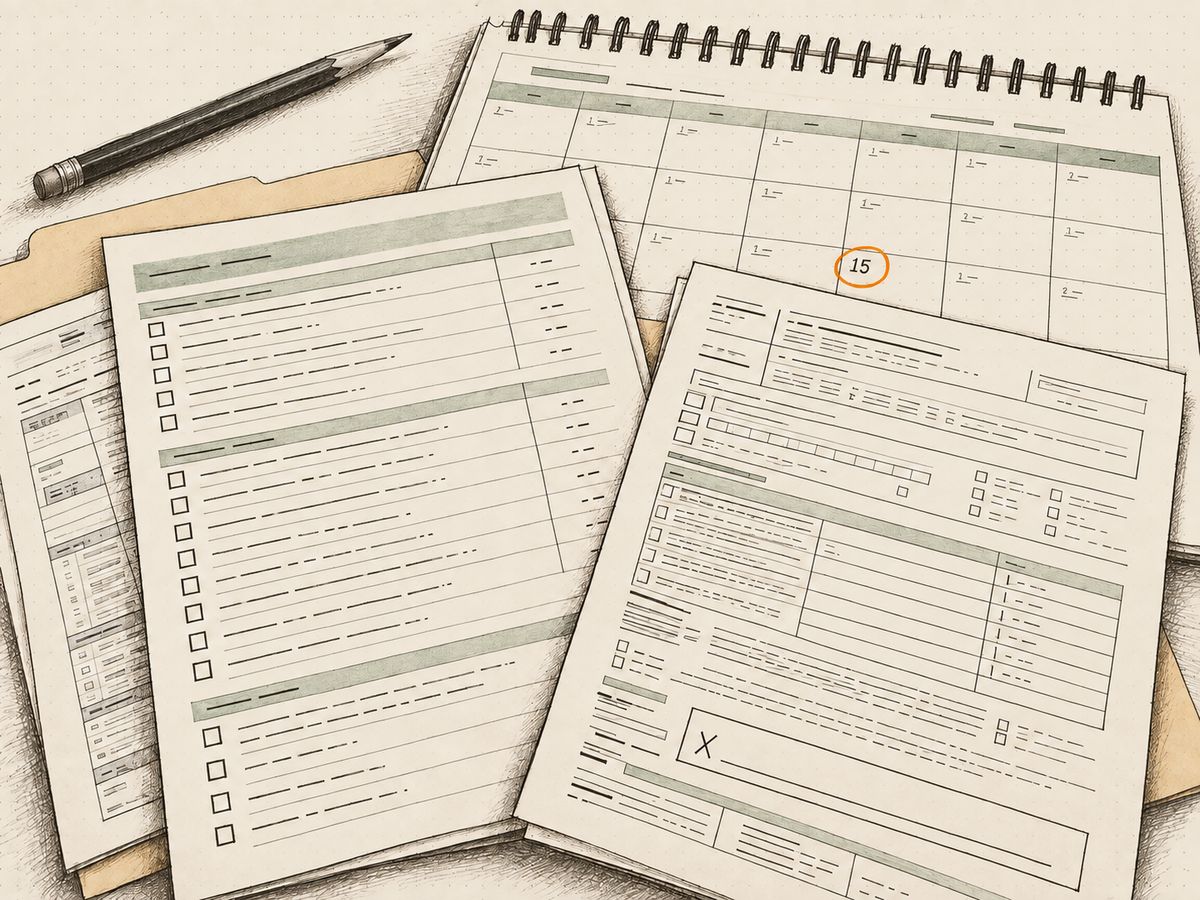
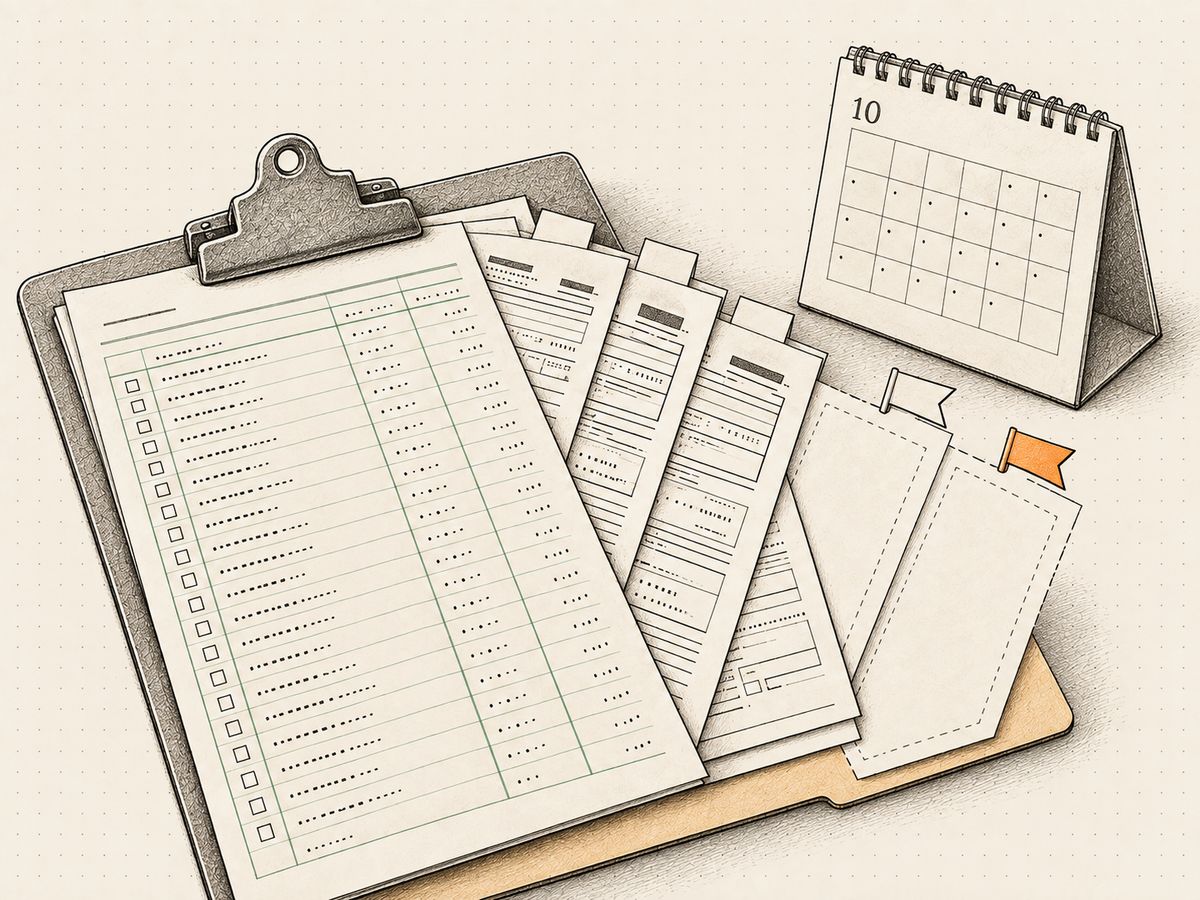
You still chase every document by hand,and open the return three times.AI automation for accounting, bookkeeping and tax firms, built on the software you already run. Your preparers open each return once, and you see what every client pays you against the hours it takes.
Your people know the code. HAIBRID Consulting builds the systems that carry everything around it: the asking, the chasing, the checking and the billing, on every return and every monthly close.
Your preparers give the season to judgment, April ends on schedule, and the firm grows without the admin growing with it.
One return, start to finishFollow return 0418 from the engagement letter to the number it earned you.
An S-corp owner with two rental properties and a brokerage account. Five things have to happen before the return is filed and your firm knows what the client paid for the hours it took. A monthly bookkeeping client runs the same loop twelve times a year, on bank statements instead of W-2s.
Example · Return 0418 · S-corp owner, two rentals, one brokerage account
The route of return 0418, drawn as one line through the firm with five stops, each marked by a folder tab: the engagement letter on the owner's desk; the email, the client portal and the mail tray where the documents arrive; the preparer's desk and the review desk; the signed 8879, the e-file acceptance and the invoice; and a line on the ledger of hours against fee. At each stop what stalls today falls off the line: the unsigned letter and a client asking what you need, the documents missing behind a green check, a figure circled with no source and no record of how it was checked, the days stacking up before the 8879 is signed and the invoice that waits until May, and the hours nobody counted. What we build closes each one: the letter signed and a document list built for the client, every arrival matched to that list, each figure tied to its source with the doubtful one sent to a person, the signature, the acceptance and the invoice on the same day, and the hours set against the fee with a short note each morning.
Example · Return 0418
1The client is taken on and the ask goes out
The record
The engagement letter, the organizer, the document list for this client.
Today
The letter goes out and work starts before it comes back signed. The organizer is the same for every client, so half of it does not apply and the client stops reading. Three weeks later the client asks what you need from them, after you sent the checklist, the organizer and the link to last year’s documents.
What we build
We finish setting up the practice-management system you already pay for, TaxDome, Karbon or Canopy, so the letter, the organizer and the document list go out from it in your name on the day you choose. The document list is built for this client from last year’s return and this year’s known forms: the S-corp K-1, two sets of rental statements, the consolidated 1099 from the brokerage. Nothing opens for a preparer until the letter is signed. Your deadline schedule and your late fee stay yours; the system applies them without anyone counting days.
We measure
Returns started before the engagement letter is signed.
2The documents come in, however they come in
The record
The client’s documents, across the portal, email, the mail and a photo taken at 11 at night.
Today
One upload flips the checkmark green while the client is still missing half the file. Half your clients email the documents anyway, and a few bring the envelopes unopened. Nobody can say which clients are complete without reading every attachment, so the preparer opens the return, finds the gap, and opens it again when the item lands. The answer to “what is still missing” is “I thought I sent that, can you check?”
What we build
AI reads whatever arrives, in whatever form, and matches each document to the list for that client, so the status of record says “complete” or “waiting on the K-1 and the second rental’s statements”, never “something arrived”. The file is not released to a preparer until it is complete. Reminders go out in your firm’s name, as many times as you decide, and escalate to a person on the schedule you set. When a late item lands after release, the preparer gets a short note of what changed and which lines it touches, not a raw attachment. If the file is not complete by the date you set, the extension is prepared for your preparer to file, and the client is told the same day.
We measure
Times a return is opened before it is done.
Example · Return 0418
3The return is prepared and checked
The record
The workpapers and the return in your tax software.
Today
The data entry is done by a seasonal hire, an offshore seat, or a tool that reads the forms and gets enough wrong that reviewing it takes longer than typing. The expensive part was never the typing. It is catching what one document says against what another says: the wages on the W-2 against the last pay stub, the basis on the 1099-B against the cost the client swears to, the K-1 against last year’s carryforward. And when AI touched the return, nobody wrote down how each figure was checked.
What we build
The cross-document check becomes its own step, run before review. Every figure on the leadsheet is tied to the document it came from, every disagreement is listed with both sources side by side, and the system rates how sure it is of each one. Anything below the line you set goes to a person with the reason attached. Your preparer keys the return in UltraTax, Lacerte, Drake or ProSeries as today, from a leadsheet with the questions already answered. The record of what was checked, against what, by whom and when stays with the return.
We measure
Review notes per return, and returns sent back from review.
Example · Return 0418
4The return is signed, filed and billed
The record
Form 8879, the e-file acknowledgment, the invoice.
Today
The 8879 goes out and sits. Someone checks the acceptance list by hand. The invoice goes out in May, or whenever the season lets someone sit down, and the fee on it is last year’s.
What we build
The 8879 goes out the moment the return is final and is followed in your name until it is signed. Your preparer files; the system watches for the acknowledgment, tells the client the return was accepted, and flags a rejection to the preparer within the hour. The invoice is built from the fee in the engagement letter the day the return is filed, and reminders stop the moment it is paid. A notice that arrives in August is logged against the client, drafted for your practitioner’s signature, and tracked until it is closed.
We measure
Days from return final to 8879 signed, and days from filed to invoiced.
5You see what the client cost you
The record
The hours against the fee, by client.
Today
You know the rate you charge. You learn what each client actually paid you per hour, once the reopenings and the questions are counted, when you reprice and watch who leaves. Most owners can name the difficult clients by feel. Few have the count.
What we build
Every return carries its touches, its reopenings, its late documents, its review notes and its hours against its fee, so by May you hold a ranked list: which clients outgrew their fee, which to reprice and by how much, which to let go, and what each change is likely to cost you in clients. You can ask in plain words: which business returns took more than twice their fee in hours this season? Each morning in season, a short note tells you what came in, what is complete, what is waiting on whom, and which deadline is closest.
We measure
Hours against fee, by client.
That is one return. Your firm runs the same five hand-offs on every return, every season, and the same loop every month for every bookkeeping client.
We build the chain as one system, from three of our services. Workflow Automation carries the reading, the matching, the checking and the following-up. Systems Integration keeps your portal, your practice-management system, your tax software’s records and your books in step. Business Intelligence turns the season’s records into the list of who pays you and who does not. You take on clients without adding admin at the same pace, the season ends on time, and you reprice with the numbers in front of you.
Your numbersFive numbers tell you how your firm runs a season. We count yours before we build.
Most owners have a feel for these. Few have the count. In the Proof Sprint we pull them from your practice-management system, your tax software’s history and your invoices, agree with you which one the first build should move, and read the same numbers again once it is running.
StopThe numberWhere the profession sitsYour firm
2
Times a return is opened before it is done
Where the profession sits
Nobody publishes this. Preparers describe the cost in one sentence: going back into a return and finding their place again is the time sink, not the reminder email. The only count that matters is yours.
?No published markYours to count
Your firm
2
Files complete when the preparer opens them
Where the profession sits
In a March 2026 poll of 93 tax professionals by the National Association of Tax Professionals, about three in four said they regularly run into documentation gaps while preparing returns.
3 in 4regularly meet gapsNATP poll, March 2026
Your firm
All
Hours a week moving information between tools
Where the profession sits
Intuit’s 2026 survey of 725 accounting professionals puts it at about five hours a week per accountant, with the average firm running 10 apps.
5 hrsa week, per accountantIntuit survey, 2026
Your firm
5
Collected per hour, by client
Where the profession sits
The 2025 national survey of 1,073 firms by the AICPA, the profession’s national association, with CPA.com puts the median net hourly billing rate at $170. That is the rate on the invoice. What each client actually pays you per hour, once the reopenings and the questions are counted, is a different number, and most firms have never seen it.
$170median rate on the invoiceAICPA with CPA.com, 2025
Your firm
5
Margin by line of work
Where the profession sits
Thomson Reuters’ 2026 survey of 600 tax and accounting professionals puts the margin on individual return preparation at 28% and on advisory work at 20 to 24%, against an average firm margin of 30%.
28%individual returns, against 30% for the firmThomson Reuters, 2026
By line of workEvery line of work has paperwork of its own. We build for that too.
Tax preparation
Organizers built per client and sent on your schedule. K-1s and late brokerage corrections watched for, so the return is not finished twice. Extensions prepared for your preparer the day a file misses your cutoff, with the client told. The 8879 followed to signed, the acknowledgment watched, the acceptance confirmed to the client. The notice that arrives in August logged, drafted for your practitioner’s signature and tracked to closed.
Monthly bookkeeping
The statement ask goes out on the same day each month, in your name, and stops when the statements land. Bank-feed transactions the ledger could not place are grouped into one list of questions for the client, sent once, and their answers posted back. The close is delivered on a date, every month, with the unreconciled items named.
Cleanup and catch-up
Before you quote a cleanup, the file is sized from counts the prospect can export themselves: uncleared transactions, months since the last reconciliation, the share of spend coded to miscellaneous, vendors with no documentation. You quote the $5,000 job as a $5,000 job, and the $15,000 job as what it is, with the scope written into the engagement letter.
1099 season
Every vendor paid over the reporting threshold is matched to a W-9 on file, in October, not the week before the January deadline. The missing ones are requested in your name until they arrive. You hand a complete, correctly classified filing list to whatever route your firm already files through.
Swipe for each line of work
Your clients’ dataWhere your clients’ data goes is settled in writing before anything is built.
You have been told, correctly, that a vendor’s security certificate says nothing about whether it trains its models on your clients’ returns. You have asked whether your exact setup is allowed and nobody would answer. So this is where we start.
Example · One client’s folder
01A written position on your stack
We read what each tool you run actually commits to on training rights, retention and deletion, in its own terms, and set that against §7216 (the federal rule on what a preparer may do with a client’s return information), the FTC Safeguards Rule and your WISP (the written security plan a tax firm is required to keep). You get the position in writing, with a recommended path, the consent language for your engagement letter and the paragraph for your WISP. Your practitioner or your counsel signs off on it; we give them something worth signing.
02No more access than the job needs
The first build touches your client list, your deadlines and your document templates, not return content. Each step deeper is named, consented and agreed before it happens. A data processing agreement, the contract term that actually settles training rights, is signed before any client data is read, and no tool in the build trains on it.
03Every step logged, and the log is yours
Each automated step records what it read, what it decided, how sure it was, who approved it and when. Your reviewer can open the record for any return, and so can an auditor. The record outlives the engagement.
04One name on the line
One named person is accountable in writing for regulated data before the build starts. Your preparer signs every return and files it. Nothing we build signs, files or logs in to the IRS on your firm’s behalf.
Why HAIBRID, for a firmWe built for paperwork that has to reconcile before we built for your firm.
You will not spend the first call explaining what a K-1 is, or why a green check in the portal means nothing.
One of ours · Steps 2 and 323
A tax filing cycle carried end to end by agents, with the privacy controls in code
A system of ours carries a federal filing cycle from start to finish for one filer. It begins at the IRS account and the transcripts, so the cycle starts from what the agency has on record. It takes in platform exports, spreadsheets and receipts scanned out of email, sorts the transactions, builds the forms as typed data so a missing value fails before filing instead of after, and reconciles the finished return against the transcript and the imported data before anything is filed. The data sits encrypted at rest, a check at every commit blocks personal identifiers from ever reaching the code, and the automation that works the filing site carries no personal data of its own. The first working version was built in three days.
One of ours · Step 22
A scanned form read in about 23 seconds, with a rating on every field
Another build of ours reads a scanned accident report into a law office’s case software in about 23 seconds and rates how sure it is of every field. By hand the same intake takes 30 to 60 minutes. A W-2, a 1099 and an organizer page are the same kind of document, and we read them the same way.
One of ours · Steps 1 and 414
Five production workflows delivered in 25 days, each with a one-tap approval
For a sales team we built five workflows that ran every night, put the results in front of the team lead as cards each morning, wrote to their records on one tap, and flagged any failure as it happened. Your engagement letters, your 8879 follow-ups and your extension list run the same way: on schedule, in your name, with a person’s yes where you want one.
One of ours · Every step12345
A firm that runs on what it sells
Our own company is run by teams of agents we built, from the research to the delivery. Our founder held the profit and loss for a business unit of about $3B at a Fortune 250 enterprise, and built the analytics that showed which accounts were slipping before the revenue left. Hours against fee, by client, is the same reading at your firm’s size.
“We already pay for TaxDome. Why isn’t that enough?”
The portal tells you a document arrived. It does not tell you the client is done. We finish setting up what you already pay for, then build the completeness check around it, across the portal, email and the mail, so the status you look at is the truth.
“We tried AI data entry for a season. It cost us more time than typing.”
We do not sell typing. The expensive step is catching what one document says against another, and writing down how each figure was checked. That check is what we build, with a record on every return. Your preparer keys from a leadsheet that is already right.
“Is my exact setup allowed under 7216? Where does my clients’ data go?”
You get the answer in writing before anything is built: what each tool commits to, where that lands against the rule, the consent language for your engagement letter and the paragraph for your WISP, with your practitioner or counsel signing off. No tool in the build trains on your clients’ data, and the first step touches no return content at all.
“My clients won’t use the portal.”
They do not have to change. We read what arrives however it arrives: the portal, the email, the photo at 11 at night, the envelope your front desk scans. Your clients see your name and your schedule, nothing else.
“AI is coming for my individual clients.”
It is, from vendors selling bookkeeping and filing straight to small businesses by the month. The firms that keep those clients are the ones with the system behind the relationship. We build that system inside your firm, in your name, and you own it when we leave.
“We bought Karbon last year and never finished setting it up.”
That is the most common thing owners tell us about their software. Setting it up is slow-season work that never gets a slow season. We finish it: the pipeline stages, the templates, the automations, the client records, configured around how your work actually moves and your people trained on it.
“Who signs? Who files?”
Your preparer, as today. Nothing we build signs a return, files one or holds your IRS login. The system does the reading, the matching, the checking and the following-up, and brings your people what needs a person.
“What does it cost?”
Every project is priced against a number from your own firm: the hours the season takes back, the seat you would otherwise hire, the clients you reprice. The Proof Sprint is a short, paid first phase, and it ends with a build working on your own files before you commit to the rest.
“I don’t have time for this. Season starts in January.”
We do the building. Your part is walking us through one return’s path, answering questions as they come up, and saying yes before anything goes live. The build runs beside your season and switches over when it is right.
“Who fixes it after you’re gone?”
We hand it over working, with a written record of how a return ran before and how it runs now, how each connection works, and who does what when a vendor changes a screen. We keep watch for 60 days. You own all of it, including the code.
Find out where your firm loses its season.
Get your Operations X-ray, our free first look at your operation. Or book a call and walk us through one return.
Running a firm with several offices, or already building your own tools with AI and wanting someone to own the direction? See the Fractional AI Officer.